

Italy’s top tourist spot is the Colosseum, originally known as the Amphitheatrum Flavium. You will discover details on tickets and guided tours for the Colosseum here.
Contents

Affiliate Disclosure
Entry & Opening Hours
 16°C, Cloudy
 24° / 12°
  67%
67%
 19° / 15° 100%
Show 5 more days
21° / 13° 17%
 19° / 9° 51%
18° / 11° 65%
18° / 9° 62%
18° / 10° 62%
19° / 9° 51%
18° / 11° 65%
18° / 9° 62%
18° / 10° 62%
We’re on the ground in Rome and keep colosseum-rome.it up to date: opening hours and weather in real time, plus every change to entry, rules and tickets that matters for your visit.

Arrive in good time for your reserved entry slot — allow about 15 minutes for the security check. Since tickets are issued in your name, you’ll need to bring your original ID; a copy isn’t accepted.
Dangerous objects, alcohol, glass containers, spray cans and large luggage aren’t allowed inside, and there’s no left-luggage facility.
The Colosseum opens at 8:30; the Archaeological Park (Roman Forum and Palatine Hill) opens a little later at 9:00, but closes at the same time as the Colosseum. For the exact hours over the next seven days, see the live schedule above
The Colosseum’s closing time follows sunset, and shifts several times a year:
- late March, with the begin of daylight saving time, to late September: 7:15 p.m.
- October, until the end of daylight saving time: 6:30 p.m.
- late October, with the begin of standard time, until the end of February: 4:30 p.m.
- until the clocks switch back to daylight saving time at the end of March: 5:30 p.m.
All tickets shown here are offered by partners officially accredited by the Colosseum, so you can compare every available option and book directly — no separate registration needed on different sites.
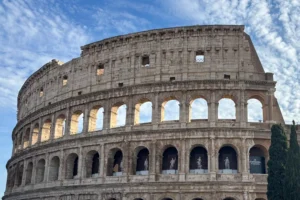
Why you should book your Colosseum ticket in advance
Those who arrive at the Colosseum without prior preparation can expect long waits – especially during peak season. With an online ticket for the Colosseum, you not only secure entry but also skip the line.
Colosseum entrance fees & tickets
There are a variety of different tickets available for the Colosseum. The best availability is with combination tickets, such as
- Colosseum & Mamertine Prison (from 35 euros), where, according to legend, the Apostle Paul was imprisoned. Many famous prisoners awaited their fate in this gruesome 7th-century BC dungeon, also known as the Tullianum.
- Guided tours of the Colosseum, the Roman Forum and the Palatine Hill (from approximately 50 euros)
There are also
- The standard Colosseum + Roman Forum + Palatine Hill ticket costs €18 plus booking and service fees from the Colosseum’s official partners. They offer 24-hour support and other additional services. The ticket includes access to the 1st and 2nd floors of the Colosseum and its informative exhibitions. Other areas, such as the Arena, are not included.
- The Arena Ticket is for a short visit to the arena. A private entrance leads directly into the arena, allowing you to admire the interior of the Colosseum for 20 minutes. There are also several sites (super-sites) in the Roman Forum and on the Palatine Hill that aren’t accessible with the standard ticket.
- the tour of the arena and the underground (hypogeum), where the stage equipment was located,
- the night tour “La Luna sul Colosseo”, which is only available during the summer time.
- The tour of the arena and the upper floors. This tour usually sells out within seconds and can only be booked on the Colosseum’s official website (colosseo.it).
Official website or partner – where should you book?
There are two ways to get a Colosseum ticket: directly from the Parco archeologico del Colosseo or through an accredited reseller. Which one is right for you comes down to one question: how much is your time in Rome worth?
The official ticket: cheap, but a matter of luck
The basic entry ticket without extras is only available on colosseo.it or at the ticket office on site. Online, tickets are released gradually in batches – and then thousands of people around the world sit in front of their screens trying to grab one. Often it doesn’t work out, even after repeated attempts over several days. Whether you book 30 or 7 days ahead makes little difference: it’s pure luck.
Some experiences are only sold on the official website, such as visits to the upper levels, night tours or the Passaggio di Comodo. These tickets, however, usually sell out almost instantly.
That leaves the ticket office on site – where you should expect long queues.
The partner ticket: plan with confidence
Accredited resellers receive their own ticket allocations, but they’re not allowed to sell the ticket on its own – only together with an extra service, such as an audio guide, a guided tour or a combination with the Mamertine Prison. That’s why the price is higher than the official base price. In return, you usually get your ticket with the extras included and without waiting, so you can plan your day in Rome with confidence.
Do the math: time is money
Here’s a simple calculation: if you spend an average of €200 a day on travel and accommodation and have 12 hours for sightseeing, every hour in Rome costs you around €16.70. With a long-haul flight and a week in a hotel, you’ll quickly reach €300 a day – that’s €25 an hour.
An hour in the queue at the ticket office often costs you more than the surcharge for a partner ticket – especially since an audio guide or guided tour is included.
The same goes for the first Sunday of the month: admission is free, but tickets are only available at the ticket office on site – and the queue that day is even longer than usual. So the visit is only free at first glance.
Our recommendation
- Plenty of time, small budget – as a backpacker, for example: try your luck on colosseo.it or join the ticket office queue early.
- Limited time, fixed itinerary: book with a partner. You save hours, your ticket is guaranteed and you get an audio guide or guided tour on top.
Wherever you book: tickets are issued in your name, so bring a valid original ID.
Tickets
In addition to entrance tickets and guided tours, there are also convenient combination tickets at interesting prices.
Combi ticket Colosseum & Mamertine Prison, valid for a visit to the ancient dungeon on the edge of the Roman Forum, where, according to legend, the Apostles Peter and Paul were incarcerated. Valid for a visit to the Palatine and Roman Forum and for a visit to the Colosseum at the reserved entrance time.
High availability!
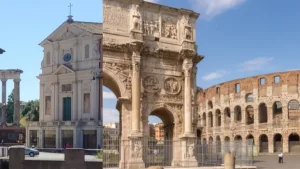
The tickets are valid up to 24 hours for a visit to the Palatine Hill and the Roman Forum, before or after the time reserved for the Colosseum. They are valid for the first and second levels of the Colosseum, including the exhibitions.

The Arena Ticket gives you access to the Palatine Hill, Roman Forum and allows you to visit the Colosseum at the reserved entrance time.
In addition to the Arena tour, the ticket allows access to the museum on the Palatine Hill and some archaeological sites not normally accessible.
When booking, you can choose between a 90-minute guided tour of Rome or a day ticket for the hop-on hop-off bus.
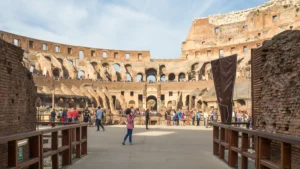

The Rome Tourist Pass includes tickets and reservations for the Colosseum, the Vatican Museums, a guided tour of St. Peter’s Basilica and other options.
High availability!
Guided tours
A guided tour offers many benefits and ensures a memorable experience by providing entertainment and a deep understanding of the advanced stage technology and architectural achievements of the ancient Romans.
In addition to guided tours of the first and second levels of the Colosseum, the Roman Forum and the Palatine Hill, there are also guided tours with access to the Arena and guided tours with access to the service corridors under the ancient Arena.
Getyourguide: a wide range of guided tours
As the name suggests, Getyourguide offers a wide range of guided tours. Getyourguide is one of the largest booking portals and offers a large selection with round-the-clock customer service. You book on our site at the original GYG prices.
Practical tips
How much time you need for the Colosseum
Allocate approximately one hour for the first and second levels of the Colosseum, including the exhibitions. Prior to or after your visit to the Colosseum, take the opportunity to explore the Imperial Forums, the Roman Forum, and the Palatine Hill. We suggest dedicating two to three hours for these attractions.
We recommend setting aside two to three hours for these sights. The Imperial Forums are part of the Museums of the City of Rome, but you can walk through from the Imperial Forums to the Roman Forum free of charge with your ticket. To do this, use the entrance at the Column of Trajan, next to Piazza Venezia. Alternatively, you can enter the Roman Forum at Via Salara Vecchia and exit either at the Arch of Titus or Via di San Gregorio.
While the Colosseum and the Archaeological Park are national museums, the Imperial Forums are part of the Museums of the City of Rome. However, you can freely cross from the Imperial Forums to the Forum Romanum with your ticket. You can access this route through the entrance near the Column of Trajan, next to Piazza Venezia. Alternatively, you can enter the Forum through Via Salara Vecchia and exit at either the Arch of Titus or Via di San Gregorio.
How to get to the Colosseum
The Colosseum is easy to reach by public transport. The hop on hop off buses also have a stop at the Colosseum. Info about the hop on hop off buses
At the Colosseum is the stop of Metro Line B “Colosseo”. Line B crosses three important train stations:
- Termini Central Station, junction for the connections to the airports and transfer station to Metro Line A, which leads through the center to the Vatican.
- Ostiense train station, from which you can go to the port of Civitavecchia and further north to Pisa and Genoa. The railway line to Ostia Lido also begins at Ostiense.
- Tiburtina station, which handles high-speed trains between Milan and Naples on the north-south axis. Many connections to the Apennines also begin here.
Tram line 3 also passes the Colosseum. The tram is slow, but the route is picturesque. Coming from Trastevere, it leads past the pyramid and the Colosseum and continues to the Basilica of St. John, Santa Croce in Gerusalemme and San Lorenzo and to the zoo.
From Piazza Navona you can take buses 81 and 87 to the Colosseum, from Via del Corso take buses 51 or 85.
Of course, the Colosseum is also very easy to reach on foot. From Piazza Venezia you take Via dei Fori Imperiali, from Circus Maximus Via di San Gregorio.
Frequently asked questions about Colosseum tickets
Do I need a ticket for the Colosseum in Rome?
Yes, admission is not free (with the exception of the 1st Sunday of the month). A ticket is required – even for children (possibly with free admission, but with reservation).
Can I buy Colosseum tickets on site?
Yes, but it is strongly recommended to buy tickets online to avoid waiting times.
What is included in the Colosseum Combo Ticket?
The combined ticket includes entry to the Colosseum, the Roman Forum and the Palatine Hill – valid for 24 hours.
Are there guided tours in English?
Yes, several providers offer English Colosseum tours including direct entry.
Are dogs allowed in the Colosseum?
No, only assistance dogs (e.g. guide dogs, therapy dogs) are permitted inside the Colosseum itself. Small dogs under 10 kg may accompany visitors to the Roman Forum and Palatine Hill in a suitable carrier.
What bags can I bring into the Colosseum?
Only small bags up to 30 x 40 x 15 cm are allowed. Large bags, backpacks, suitcases and trolleys are not permitted – there is no cloakroom or luggage storage on site.
Is the Colosseum wheelchair accessible?
Yes. From the “Valadier” main entrance, a lift to the upper tier is located at the end of the left oval. The Arena and the Roman Forum are also wheelchair accessible.
Is entry free for visitors with disabilities?
Visitors with a disability rating of 75% or higher receive free entry, along with a companion or assistance dog. A reservation is recommended, otherwise tickets can be collected at the ticket office. A reservation is always required for the Arena, the underground and other special areas.
What should I know about free entry on the first Sunday of the month?
Entry is free, but the Arena and underground remain closed for safety reasons. Online booking isn’t available that day – tickets must be collected in person at the ticket office.
Can I take photos inside the Colosseum?
Yes, photography is allowed, but without flash to protect the ancient structure. Tripods are banned throughout Rome, including inside the Colosseum.
What’s the best time to visit the Colosseum?
There’s no single best time to enter without a reservation – queues form virtually all day. The Colosseum itself is shaded and well ventilated, so a visit works fine even on hot days. At the Roman Forum, however, it’s best to avoid the midday heat.
Colosseum – Quick Facts
| Construction period | 72–80 AD, under Emperors Vespasian and Titus |
| Height | 48 meters |
| Length × Width | 188 × 156 meters (circumference 527 meters) |
| Ground area | approx. 20,000 m² |
| Arena dimensions | 86 × 54 meters |
| Number of entrances | 80 |
| Capacity | 50,000–80,000 spectators |
| Building material | approx. 100,000 m³ of travertine, tuff and brick, faced with marble |
| UNESCO World Heritage | since 1980 (part of the Historic Centre of Rome) |
| Visitors/year | over 14.8 million (2024) – Italy’s most visited attraction |
| Address | Piazza del Colosseo, 1, 00184 Rome |
How the Colosseum worked
The Colosseum is the largest amphitheater in the world. It is a UNESCO World Heritage Site and one of the seven new world wonders.
The Colosseum had the capacity to accommodate anywhere from 60,000 to 80,000 people. Due to the effective management of the entrances, the process of filling and emptying the theater was quicker compared to certain contemporary stadiums.

It was originally possible to flood the arena and naval battles were organized. Later, a more complex stage technology with lifts was installed. Wild animals and people could appear out of nowhere anywhere in the arena and stage sets could be set up in a few minutes.

Rome showed all its might and glory in the Colosseum. Animals from all over the world were shown and hunted in the Colosseum, there were executions and gladiator fights. The animal hunts took place in the mornings, at noon convicts fought against wild animals and in the afternoon the gladiatorial fights took place.
Read more about archaeological research in the Colosseum
History of the Colosseum
After the death of Emperor Nero in 68, his magnificent villa, the Domus Aurea, was filled up. In the area of the Colosseum there was an artificial lake that belonged to the villa. The Flavian dynasty, the new rulers of Rome, built the mighty Colosseum. It is therefore called Amphitheatrum Flavium. Construction began in 72 under Emperor Vespasian. He died in 79 and never saw completion. The inauguration took place in 80 under Titus. The inauguration celebrations lasted 100 days. The construction was financed with the treasures looted in the temple of Jerusalem.

Under Domitian, who ruled from 81, the basement was expanded with supply rooms, elevators and stage technology.
Major restoration work was necessary in 217, probably after a lightning strike. They lasted 5 years. In 250 more works were necessary after a fire caused by lightning.
After the Visigoths sacked Rome in 410, gladiator games were banned and only hunts were held. Restoration work occurred after the earthquakes in 470, 484 and 508.
In the 6th century, the Colosseum served as a burial site and later as a castle. There was major damage from an earthquake in 847 and in 1349 the southern outer wall collapsed after an earthquake. The material was used to build palaces in today’s city center. Apartments and stables were built in the Colosseum.
In 1675 the Colosseum was declared a holy place to commemorate the martyrs and in 1744 a way of the cross was built. In 1749, the Colosseum was dedicated to Christ and the martyrs.

Another earthquake occurred in 1806 and major urgent work was required. Raffaele Stern hastily erected retaining walls. On the side facing the forums, Giuseppe Valadier carried out support measures in 1823.
Restoration and research work is still being carried out in the Colosseum today. In recent years, further areas of the hypogeum with its underground supply rooms and stage technology have been made accessible. A glass elevator now leads to the upper floors of the amphitheatre. However, these areas can only be visited with special guided tours.
Read more about our new findings on the podium and imperial box.
Buying Colosseum tickets in advance saves you time, nerves and often money. Whether you are looking for a quick tour, an extensive guided tour or a combined ticket to all the highlights of ancient Rome, you will find the right option online.
➡️ Book Colosseum tickets online now and experience ancient Rome up close!
About the author
Bernhard Gemassmer is a travel expert right here in Rome. He knows from first-hand experience what really matters to visitors – and what they’re better off skipping. That’s exactly what you’ll find on colosseum-rome.it, along with fascinating insights into the latest archaeological research on the Colosseum.