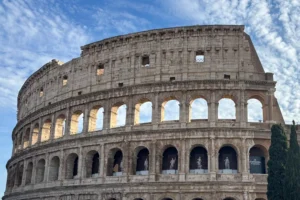
The Colosseum is the largest amphitheater in the world. Construction began in 72 under Emperor Vespasian on the site of an artificial lake that belonged to Nero’s villa, and Titus inaugurated it in 80 with celebrations that lasted 100 days. After centuries of games, repairs, earthquakes and new uses, it is today a UNESCO World Heritage Site and one of the seven new world wonders.

Affiliate Disclosure
This guide follows the history of the Colosseum from the Flavian dynasty to today, with a timeline, answers to the most common questions, and links to our in-depth reports on the archaeology and the games.
Colosseum history at a glance
- Built: 72–80 under the Flavian emperors Vespasian and Titus; underground level expanded under Domitian
- Original name: Amphitheatrum Flavium (Flavian Amphitheater); the name Colosseum goes back to the colossal statue of Nero
- Site: an artificial lake that belonged to Nero’s villa, the Domus Aurea
- Financing: treasures looted from the Temple in Jerusalem
- Size: 188 × 156 meters, 48 meters high, 80 entrances
- Capacity: between 50,000 and 80,000 people
- Games: last recorded gladiator fights around 435, last animal hunts in 523
- Today: UNESCO World Heritage Site since 1980 and one of the seven new world wonders
Timeline of the Colosseum
| Year | What happened |
|---|---|
| 64 | After the great fire of Rome, Nero builds his villa, the Domus Aurea, with an artificial lake |
| 68 | Nero dies; the Domus Aurea is filled in |
| 72 | Vespasian starts building the Flavian Amphitheater on the site of the lake |
| 79 | Vespasian dies without seeing the building completed |
| 80 | Titus inaugurates the Colosseum; the celebrations last 100 days |
| from 81 | Under Domitian, the underground level is expanded with supply rooms, lifts and stage machinery |
| 217 | Major restoration after a probable lightning strike; the work drags on for almost twenty years |
| 250 | Further repairs after a fire caused by lightning |
| 399 and 404 | Emperor Honorius reportedly bans gladiator combat |
| c. 435 | Last recorded gladiator fights; afterwards only animal hunts continue |
| 470, 484, 508 | Restoration after earthquakes |
| 523 | Last recorded animal hunts |
| 6th century | The Colosseum serves as a burial site and later as a castle |
| 847 | Earthquake causes major damage |
| 9th–14th century | Apartments and workshops are built into the arches |
| c. 1200 | The Frangipani family fortifies the Colosseum |
| 1349 | The southern outer wall collapses in an earthquake; the stone is used for palaces |
| 1360s | The Confraternity of Saint Salvator moves into the northern part |
| 1675 | Declared a holy place in memory of the martyrs |
| 1744 | A Way of the Cross is built |
| 1749 | Dedicated to Christ and the martyrs |
| 1806 | Earthquake; Raffaele Stern hastily erects retaining walls |
| 1813 | A marble block with fragments of the dedication inscription is found |
| 1823 | Giuseppe Valadier reinforces the side facing the forums |
| 1980 | Listed as part of the UNESCO World Heritage Site “Historic Centre of Rome” |
Before the Colosseum: Nero’s villa and its lake
After the great fire of Rome in 64, Emperor Nero built a magnificent villa, the Domus Aurea (Golden House), in the middle of the city. Its grounds included an artificial lake on the site of the future Colosseum, and a colossal bronze statue of Nero stood nearby. After Nero’s death in 68, the villa was filled in.
Who built the Colosseum, and when?
The Flavian dynasty, Rome’s new rulers, built the mighty Colosseum, which is why it is called the Amphitheatrum Flavium. Construction began in 72 under Emperor Vespasian, who died in 79 without seeing it completed. The construction was financed with the treasures looted from the Temple in Jerusalem. A marble block with fragments of the dedication inscription was found in 1813; it speaks of the new amphitheater built from booty. You can read how the building phases are reconstructed in our report on Colosseum archaeology.
The Colosseum in numbers
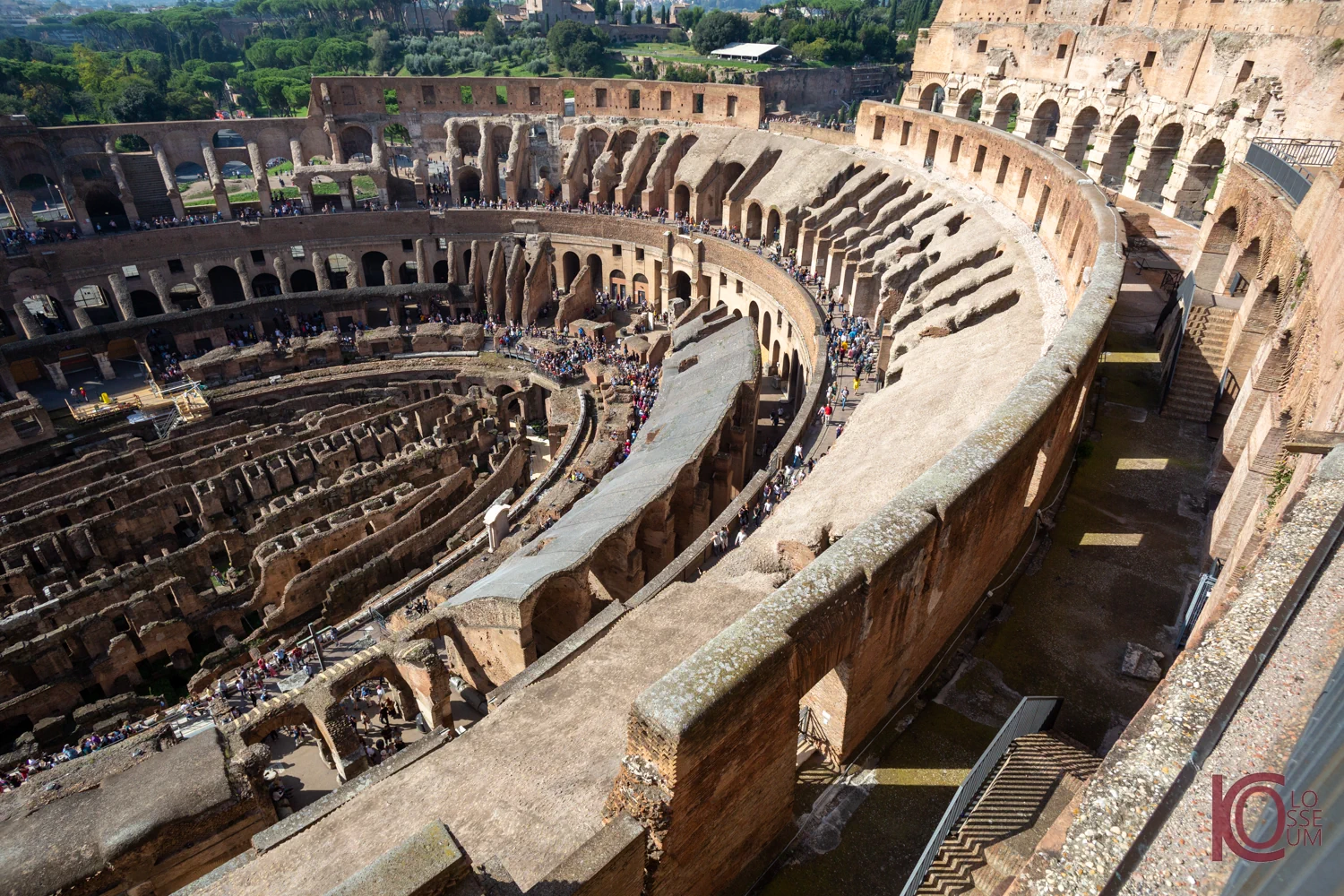
The Colosseum measures 188 × 156 meters (circumference 527 meters) and is 48 meters high. It covers a ground area of about 20,000 m², and the arena measures 86 × 54 meters. About 100,000 m³ of travertine, tuff and brick were used, faced with marble. 80 entrances and efficient crowd management made it possible to fill and empty the building faster than some modern stadiums.
The inauguration in 80
The inauguration took place in 80 under Titus, and the celebrations lasted 100 days. The Colosseum could hold between 50,000 and 80,000 people.
Domitian and the underground level
Under Domitian, who ruled from 81, the underground level was expanded with supply rooms, elevators and stage machinery. Wild animals and people could appear out of nowhere anywhere in the arena, and stage sets could be put up in a few minutes. Originally, the arena could be flooded for naval battles. How the machinery worked is explained in our report What happened in the Colosseum.
What took place in the Colosseum
Rome showed all its might and glory in the Colosseum. Animals from all over the world were displayed and hunted there, and there were executions and gladiator fights. The animal hunts took place in the morning, convicts fought wild animals at noon, and the gladiator fights followed in the afternoon.
Why is it called the Colosseum?
The Romans called the building the Amphitheatrum Flavium. The name “Colosseum” most likely comes from the Colossus, the colossal bronze statue of Nero that stood beside it and was later remodeled as the sun god. The name only became common in the Middle Ages.
Repairs and the end of the games (217–523)
Major restoration work was needed in 217, probably after a lightning strike, and dragged on for almost twenty years. In 250, further work became necessary after a fire caused by lightning. Emperor Honorius reportedly banned gladiator combat in 399 and 404, yet the last gladiator fights in the Colosseum are recorded around 435, after which only hunts were held. Restoration work followed the earthquakes in 470, 484 and 508. The last animal hunts are recorded in 523.
From burial site to fortress and housing: the Middle Ages
In the 6th century, the Colosseum served as a burial site and later as a castle. Around 1200 the Frangipani family fortified it. Between the 9th and the 14th century people lived and worked inside the arches, and in the 1360s the Confraternity of Saint Salvator moved into the northern part of the building.
Earthquakes and stone robbing
An earthquake in 847 caused major damage, and in 1349 the southern outer wall collapsed after another quake. The material was used to build palaces in today’s city center, and apartments and stables were built inside the Colosseum.
A holy place and the first rescue work (1675–1823)
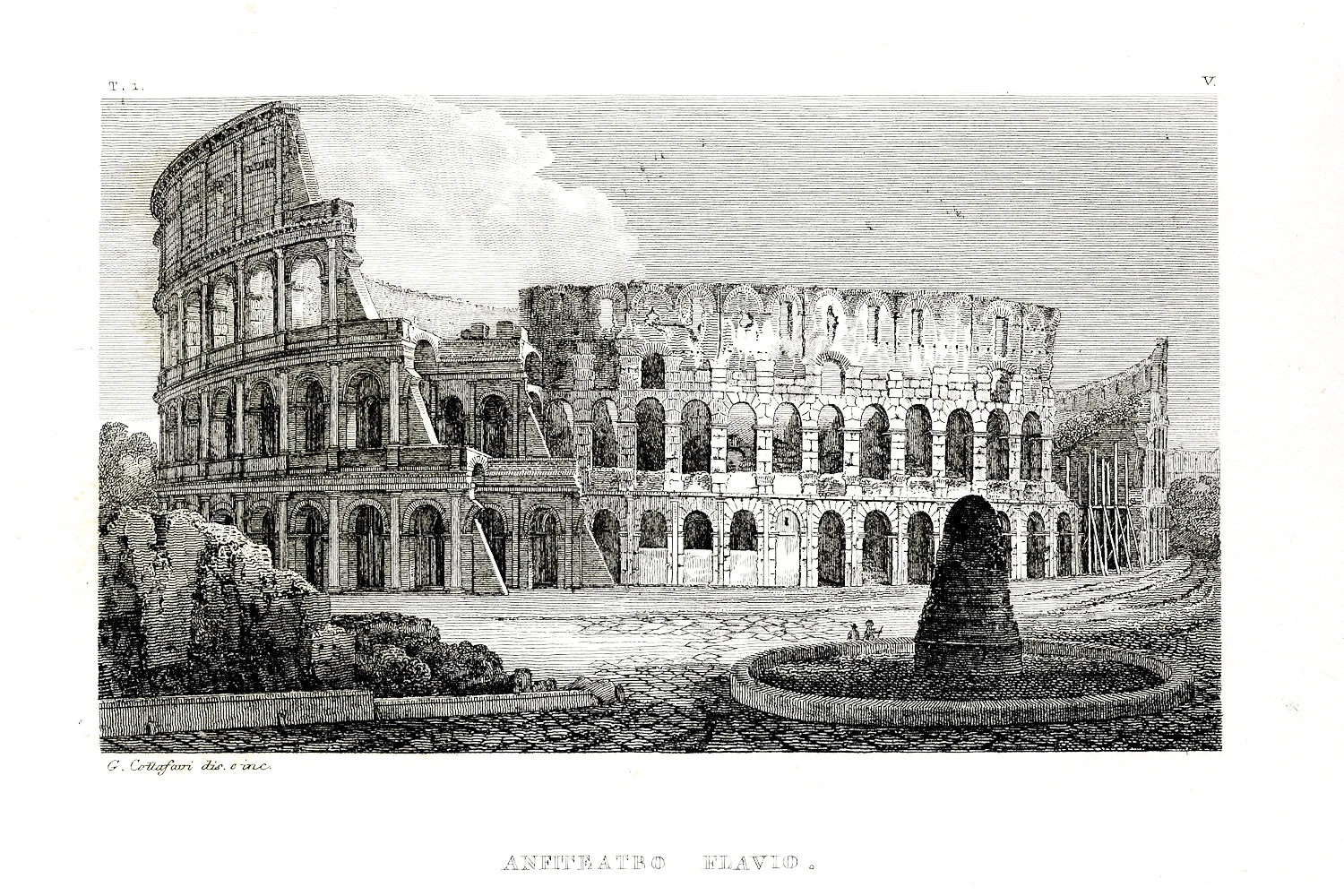
In 1675 the Colosseum was declared a holy place to commemorate the martyrs, and in 1744 a Way of the Cross was built. In 1749, the Colosseum was dedicated to Christ and the martyrs. Another earthquake occurred in 1806 and major urgent work was required. Raffaele Stern hastily erected retaining walls. On the side facing the forums, Giuseppe Valadier carried out reinforcement work in 1823.
Restoration and research today
Restoration and research work is still being carried out in the Colosseum today. In recent years, further areas of the hypogeum with its underground supply rooms and stage technology have been made accessible. A glass elevator now leads to the upper floors of the amphitheater. However, these areas can only be visited with special guided tours; see our guide to arena and underground tickets. Our report on the podium and imperial box covers the latest findings.
Frequently asked questions about Colosseum history
When was the Colosseum built?
Construction began in 72 under Emperor Vespasian, who died in 79 without seeing it completed. His son Titus inaugurated the Colosseum in 80, and the celebrations lasted 100 days.
Who built the Colosseum?
The Flavian dynasty, Rome’s new rulers after Nero. This is why the building is called the Amphitheatrum Flavium (Flavian Amphitheater). Vespasian started it, Titus inaugurated it, and under Domitian the underground level was expanded.
Who paid for the Colosseum?
The construction was financed with the treasures looted from the Temple in Jerusalem. A dedication inscription, known from fragments of a marble block found in 1813, speaks of the new amphitheater built from booty.
Where was the Colosseum built?
On the site of an artificial lake that belonged to Nero’s villa, the Domus Aurea. After Nero’s death in 68, the villa was filled in.
Why is it called the Colosseum?
The name most likely comes from the Colossus, the colossal bronze statue of Nero that stood next to the amphitheater. The Romans called the building the Amphitheatrum Flavium; the name Colosseum only became common in the Middle Ages.
How big is the Colosseum?
It measures 188 × 156 meters (circumference 527 meters) and is 48 meters high. The arena is 86 × 54 meters, and the building has 80 entrances.
How many people could the Colosseum hold?
Between 50,000 and 80,000 people. Thanks to efficient crowd management at the entrances, it could be filled and emptied faster than some modern stadiums.
What happened in the Colosseum?
Animals from all over the world were displayed and hunted, and there were executions and gladiator fights. The animal hunts took place in the morning, convicts fought wild animals at noon, and the gladiator fights followed in the afternoon.
When did the gladiator games end?
Emperor Honorius reportedly banned gladiator combat in 399 and 404, but the last gladiator fights in the Colosseum are recorded around 435. Animal hunts continued until at least 523.
What happened to the Colosseum after antiquity?
In the 6th century it served as a burial site and later as a castle. Around 1200 the Frangipani family fortified it, and between the 9th and 14th century people lived and worked inside the arches. Earthquakes in 847 and 1349 caused major damage, and the stone was used to build palaces in today’s city center.
Is the Colosseum a Christian site?
It became one. In 1675 it was declared a holy place to commemorate the martyrs, a Way of the Cross was built in 1744, and in 1749 the Colosseum was dedicated to Christ and the martyrs.
Can I visit the underground of the Colosseum today?
Yes, but only with special guided tours. In recent years, further areas of the hypogeum with its underground supply rooms and stage technology have been made accessible.
Read more
- Colosseum archaeology: building phases, excavations and the hypogeum – a report by Heinz-Jürgen Beste
- What happened in the Colosseum: games, logistics and the ancient lifts – another report by Heinz-Jürgen Beste
- New insights into the Colosseum: How archaeologists are reconstructing the heart of the arena
- Colosseum tickets: prices, types and where to buy them